Recently a number of Jewish residents of Watertown petitioned the Watertown Free Public Library to remove the children’s book, A Map For Falasteen, from the 2nd Grade Summer Reading List. Choosing to select books from the list is voluntary. (Below is a partial description of the book from Kirkus. The link to the full description is also included.)
At the July 31 meeting of the Library Board of Trustees, during the public comment period, three individuals spoke in favor of removing the book and seven individuals spoke against removing the book. We have included below the statements of three of Watertown Citizens’ members/supporters who opposed removing the book. They are Merrie Najimy, Abby Yanov, and Jeanne Trubek. Watertown Citizens says THANK YOU to these individuals and others who took a stand for justice and free speech. We are pleased to say the book was not removed as the Trustees stood firm in their support for a 10-year Library policy that brought librarians and teachers together to create the volunteer reading list.
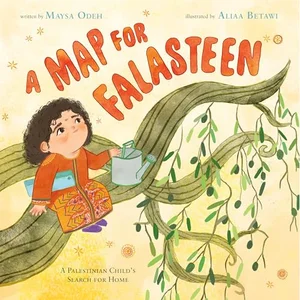
A MAP FOR FALASTEEN -A PALESTINIAN CHILD’S SEARCH FOR HOME
A young girl turns to her family members to help her answer the question, “Why isn’t Palestine on the map?” Falasteen and her schoolmates sit around a world map searching for their countries of origin. When Falasteen asks why she can’t find Palestine, her teacher responds, “I think there’s no such place.” A concerned Falasteen goes home after school, eager for answers. Her grandfather, grandmother, and mother each provide a response that tells her family’s story and strengthens her sense of identity. Drawing inspiration from her own grandmother’s experience of displacement in 1967, the author tells a poignant story of longing and sadness mixed with a persistent hope for a return to a historic homeland and reunification with family.
https://www.kirkusreviews.com/book-reviews/-odeh/a-map-for-falasteen/
Testimony of Merrie Najimy at the July 31 meeting of The Watertown Free Public Library Board of Trustee Meeting.
A Map for Falasteen by Maysa Odeh
My name is Merrie Najimy, and I am a Watertown resident of three decades. I’m a thirty-six-year, veteran anti-racist public-school educator and former president of the Massachusetts Teachers Association.
I’m here tonight to shine a light on the anti-Palestinian racism behind this campaign to censor the book A Map for Falasteen by Maysa Odeh, and to put it in the broader context of the right-wing nationalist movement that seeks to eliminate DEI, ban books, pass anti-LGBTQ+ laws, repress Academic Freedom and speech that supports Palestinian human rights and dignity specifically, and the First Amendment generally, and deny birthright citizenship while revoking status from naturalized citizens.
Anti-Palestinian racism is a form of racism that silences, erases, excludes, defames or dehumanizes Palestinians, and their history and narratives.
You see it manifested in both the act of calling to drop the book from the summer reading list, and in the mass email message demanding that it be examined. The false accusations that the book presents a “one side” view and “indoctrinates children” come straight out of the playbook to silence. In fact, it is an Orwellian projection of what the accusers do. It is also belittling to educators, parents and caregivers to presume they don’t know how to talk about complex subjects with their own children.
Educators and librarian have always been under attack by fascist movements, because they are amongst those on the front lines defending democracy and free speech by challenging racism, authoritarianism, and censorship. Trust your judgement and that of educators, parents and caregivers who know how to raise sensitive subject with their own children. Keep the book A Map for Falasteen by Maysa Odeh on the summer reading list.
Thank you, Merrie Najimy
Testimony of Abby Yanow at the July 31 meeting of The Watertown Free Public Library Board of Trustee Meeting.
My name is Abby Yanow. I’m an educator, trained mediator and peace activist. I think
“The Map of Falasteen” is an excellent book to include on your reading list for several
reasons.
When I lived in Israel as a teenager, I was unaware of the lives of Palestinians, because
Jewish Israeli society intentionally ignores Palestinian history and their existence.
From a pedagogical perspective:
1. Every child wants to know where their family comes from, to achieve the
developmental goal of forming an identity – so this book of memories of the girl’s
grandparents about their villages is entirely appropriate for all students of any
ethnicity.
2. The school department and parents seem to value cross-cultural understanding,
which makes this book a good choice.
From a political perspective:
1. To claim that this book aims to replace Jewish Israelis or the state of Israel with
Palestinians is a willful misinterpretation. The fact is that the Palestinians live
within the state of Israel, without their own state, lacking equal rights and
suffering oppression of all kinds. They deserve to live in a democracy, whether
in their own state or within Israel as a bi-national state.
2. This book has no content that denies the humanity of Jewish people. We
wouldn’t expect histories of Jewish people to mention Palestinians, so this should
not be a criterion for excluding this book.
3. Lastly, we should not ban books in order to achieve political goals, which is what
authoritarian governments do. Let Watertown hold ourselves to a more
enlightened and democratic standard.
Addendum: For the Jewish people who are opposed to including this book, I hear their
concerns and fears about “not being included on the map” and “not being seen to exist”.
As a Jewish woman who grew up continually learning about the Holocaust, I also
inherited this mentality of being en-garde against potential erasure. I understand this as
inter-generational trauma which has been passed down to each Jewish generation
since WWII. We need to be sensitive to these feelings, and my support of this book is
not meant to dismiss them. We can do both: acknowledge people’s feelings and
support the inclusion of this book.
Testimony of Jeanne Trubek at the July 31 meeting of The Watertown Free Public Library Board of Trustee Meeting.
The children’s book “A Map for Falesteen” is a sweet, gentle, age-appropriate book written to
reassure Falasteen (a young child) that the place her grandparents and parents came from
really does exist, although the name has changed and they may not return. At school the
children are asked to find the country their families come from. Falasteen looks for Palestine
and cannot find it. Her teacher says that it does not exist. This upsets Falasteen, so at home
after school she asks her grandparents and her mother. They reassure her that Palestine
exists: in the food, the traditions and in all their hearts. This book has received much praise –
some examples of readers’ comments (taken from the web) are:
This is a story of family, resilience and home always being where the heart is.
The pictures are absolutely beautiful and the meaning of the book was so precious.
The objections to this book for second grade comes from the Camera Education Institute, an
organization headquartered in Boston that has appointed itself to monitoring all levels of
education for suspected antisemitism. They have difficulty with finding a problem with this
book and must revert to claiming that Palestine has never existed. This would not be
challenged by second graders. When they are older they may learn that Palestine was part of
the Ottoman Empire from 1516 to 1917,and that after the Ottomans were defeated in World
War I, Britain was awarded control of much of the Mideast and had a British Mandate for
Palestine. Britain, never consulting the mix of people who lived in the area – Christian,
Jewish, Muslim – decided to award this land to the Zionists, and that was the beginning of this
most difficult period. (Lesson: don’t give away stuff that you don’t own).
Watertown’s library has many other books for elementary school children intended to help
them cope with issues that arise when your family has been expelled from their previous
home. One remarkable book is a book in verse about an Armenian who fled Kars in Turkey
during the Turkish War against Armenia – The Honey Jar, by Joan Schoettler. Again, it is told
from the child’s perspective and is gentle although it must deal with loss and death. Similarly
“Mary and the Trail of Tears” by Andrea Rogers gives a child’s view of being expelled from
southeast United State as U.S. soldiers removed the Cherokee People, forcing them west to
Oklahoma. Being expelled from your homeland is traumatic; many times this has occurred
and we as the adults must do our best to help children understand what happened. These
books help – help the children understand, and help them realize they are not alone.
I, as a citizen of Watertown, do not want censorship of my reading or of any other’s reading.
Please do not remove this lovely book from the library.
Jeanne Trubek
471 K Arsenal St.
Watertown, MA