
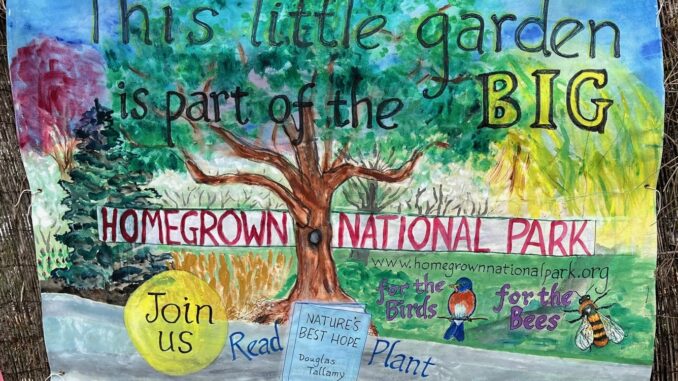
For the 27th Life-Friendly Garden Tour, held in fall 2024, we explored how our gardens are part of Homegrown National Park. Homegrown National Park is a challenge raised by University of Delaware professor and best-selling author Doug Tallamy. If we replaced half of what is now lawn nationwide, that could restore roughly 20 million acres — an area larger than any single National Park — to diverse ecosystems.
For an introduction, it’s hard to beat watching Dr. Tallamy give his talk. That’s why at our August 2024 Monthly Meeting we showed a video of him explaining the idea of stitching together millions of tiny habitats to create a 20-million-acre sanctuary for biodiversity in the United States. He’s a fascinating speaker and shares wonderful photographs of the plants and animals he studies.
Our own Garden Tour is all about using no chemical insecticides, fertilizers, or herbicides. Thes lays the foundation for a vital ecosystem. You can learn more about the history of the Garden Tour here.
The next step is to restore the native plants that our native bees, butterflies, moths, and birds coevolved with. The most important plants are the 14% of plant species that support 90% of the food chain: keystone native plants. It’s also important to remove invasive plants with origins in other regions of the world. Since the animals that eat them are not here, these non-native plants run rampant and fill space. If you would like to help remove invasive plants from our green spaces, check the Events page on Watertown Community Gardens for the next opportunity.
Instead, if you have space to plant a new tree, an oak will support by far the widest variety of caterpillars. Caterpillars are what most birds feed their young, the majority being moth caterpillars. Since moths need dark nights, you can help them by turning off artificial lights at night or using motion detecting lights. The leaves that fall under trees, if left in place, provide safe places for overwintering moths, butterflies, ladybugs, and other beneficial insects. You can increase overwintering habitat by adding “soft landing” plants, such as ferns and grasses.
If everyone did just one of these things, whether or not we have a garden, we can all contribute:
- Make our gardens safe for insects, birds, and all living beings by not using chemical pesticides, fertilizers, or herbicides.
- Reduce lawn.
- Remove invasive plants.
- Plant keystone native plants.
- Leave the leaves.
- Add “soft landings” under trees.
- Reduce artificial lighting at night.
- Get on the Homegrown National Park map!
Here is the map for Fall 2024 Garden Tour
A printable version of the map is available as a brochure here. Please refer to the online map for full descriptions of the gardens.
The green flowers indicate hosted gardens. Hosted gardens welcomed guests during the hours of the Garden Tour. Until the next tour, please be respectful and view these gardens from the street.
The golden flowers indicate unattended planting strips and public gardens. These are open for viewing from the street any time!